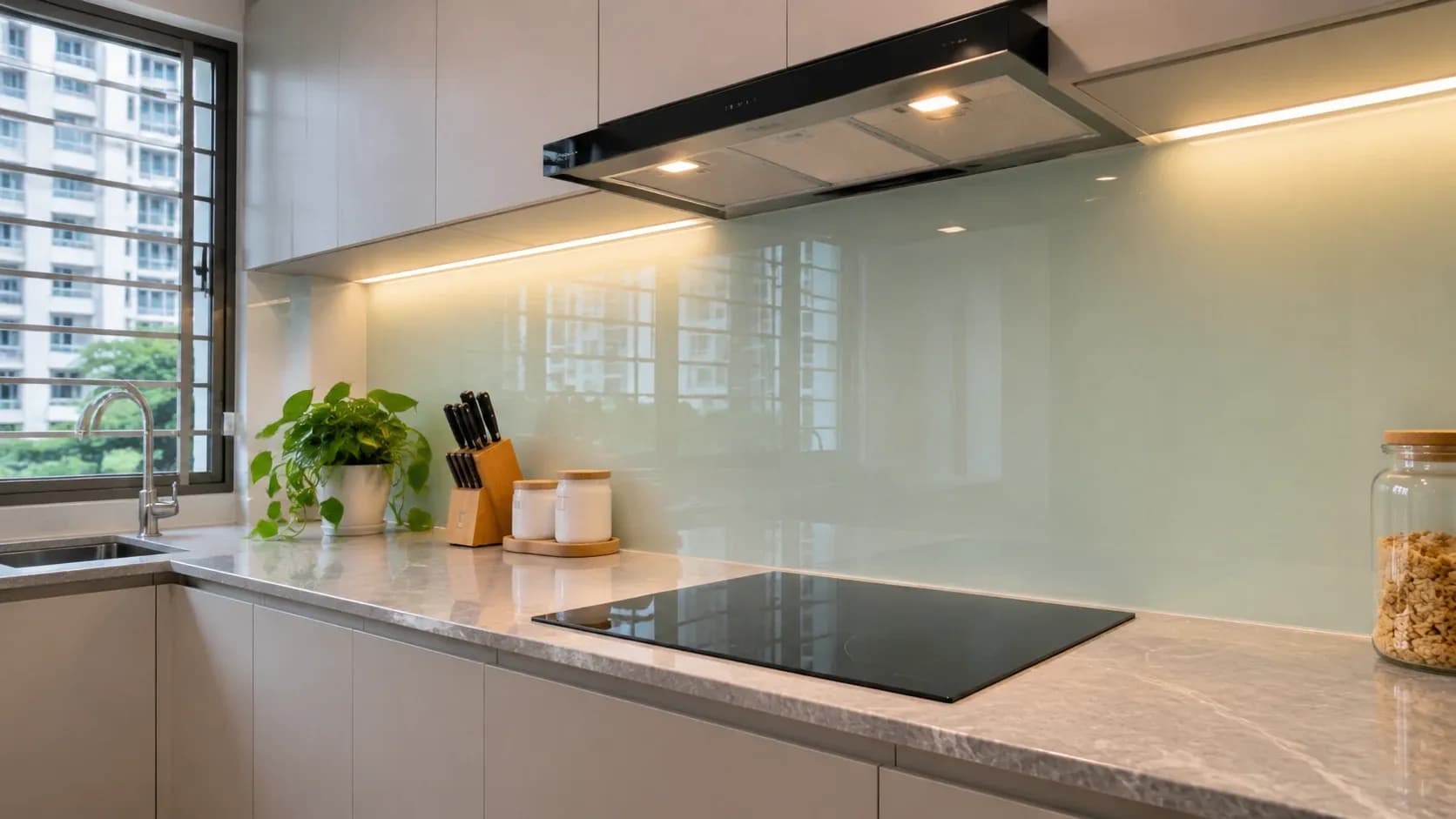
What Glass Thickness for Kitchen Backsplash Singapore?
For most residential kitchens in Singapore, 6 mm toughened (tempered) glass is a practical starting point for a kitchen backsplash. RH Glass Solution’s published interior-glass guide lists 6 mm tempered glass for backsplashes, while Singapore supplier guidance also identifies 6 mm as a common choice and notes that larger panels may call for 8 mm.
The correct specification still depends on the panel’s height and width, the number and position of cut-outs, the hob type, the manufacturer’s heat-clearance instructions, the wall surface and the fixing method. A thicker panel is not automatically the safer option; the glass type and complete installation matter just as much.
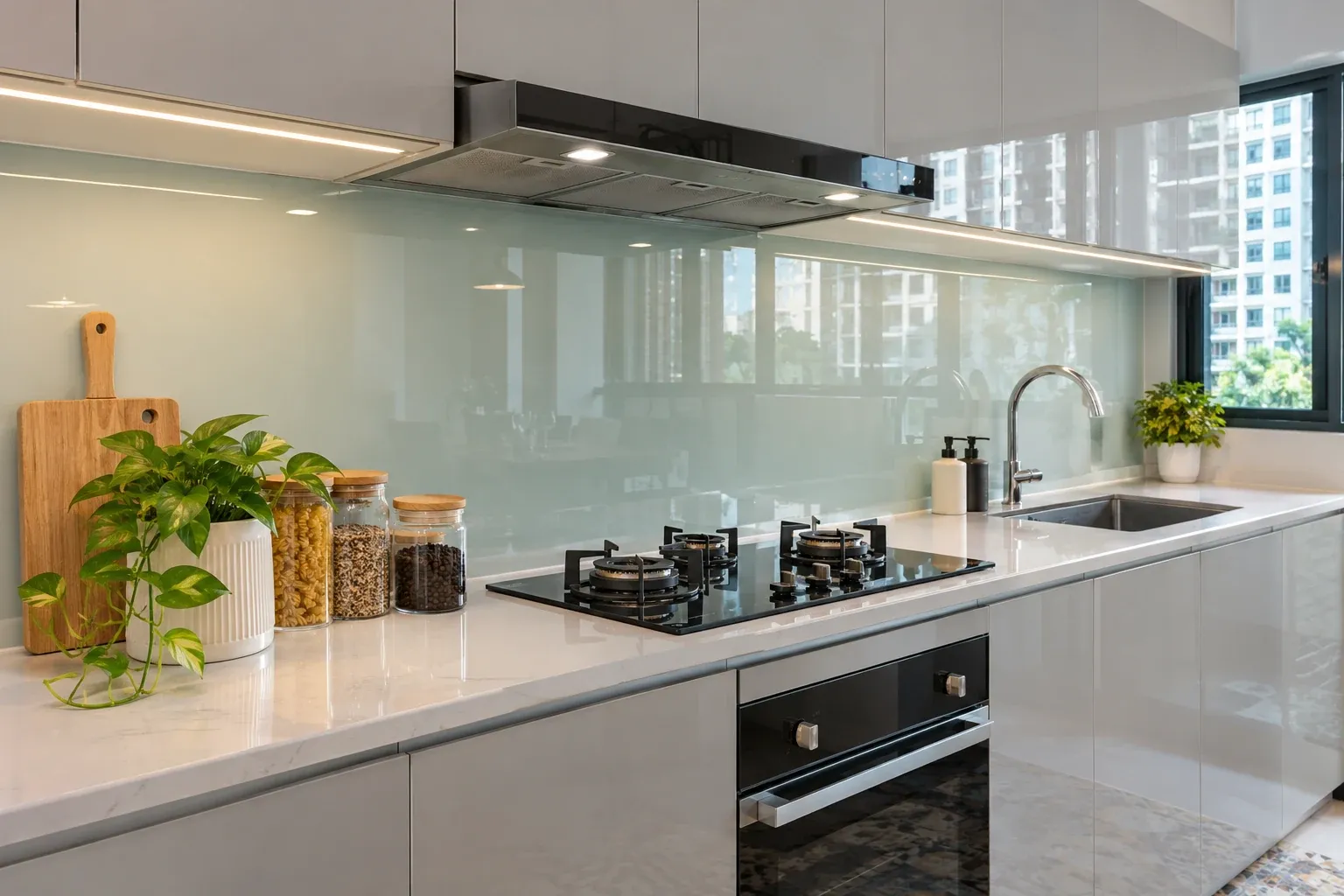
Kitchen backsplash glass thickness at a glance
Use this table as an initial guide for a discussion with your glass contractor. The final thickness should be confirmed against the selected glass product and panel design.
Thickness | Typical consideration | Where it may fit | Practical guidance |
5 mm | Product-specific wall-cladding option | Some manufacturer-approved painted-glass systems | Use only when the glass manufacturer and installer approve the panel size, location and fixing system. |
6 mm | Common residential backsplash specification | Typical HDB, condominium and landed-home kitchen layouts | A sensible starting point for most standard backsplash panels; RH Glass Solution lists this specification. |
8 mm | A thicker option that may be considered for larger panels | Wide, tall or visually substantial panels where the fabricator specifies it | Confirm whether the added thickness is needed for the actual dimensions and support method. |
Why 6 mm toughened glass is a practical starting point
A kitchen backsplash sits close to everyday cooking, washing and food preparation. It needs a surface that can be cleaned easily and a glass specification suited to the location. For many standard residential layouts, 6 mm toughened glass offers a useful balance between a neat appearance, panel rigidity and practical fabrication.
It can be made to suit the measured space between the countertop, cabinets and cooking area.
It supports common design choices such as clear, tinted and back-painted finishes, subject to product availability.
A smooth glass surface has no tile grout lines, so grease and food splashes are easier to wipe away.
It can be fabricated with planned openings for sockets and switches, provided these are measured before toughening.
When should you consider 8 mm glass?
An 8 mm panel may be considered when the backsplash is unusually wide or tall, when the design uses a large uninterrupted sheet, or when the fabricator’s specification calls for extra rigidity. It can also create a more substantial visual edge. However, the panel’s support, weight, wall condition and installation method must be checked together.
Do not upgrade to 8 mm simply because it sounds stronger. Ask the installer to explain what the extra thickness solves in your particular kitchen. If the 6 mm panel is correctly specified for the dimensions and fixing system, a thicker sheet may add cost and weight without a clear benefit.
Can 5 mm glass be used for a kitchen backsplash?
Some decorative painted-glass wall-cladding systems use 5 mm glass. For example, AGC’s Lacobel and Matelac installation guide recommends 5 mm for its wall-cladding panels above 1 m² and says very large panels may require thicker glass. This is product-specific guidance, not a universal rule for every backsplash or every area behind a hob.
Before choosing 5 mm, confirm the exact product, whether a toughened or safety-backed version is available and approved for the intended location, and whether the panel dimensions and installation method comply with the manufacturer’s instructions. Do not substitute ordinary annealed glass for a specified toughened panel.
What matters besides thickness?
1. Glass type and safety specification
Ask for the glass type to be written clearly on the quotation. Toughened glass is commonly specified for kitchen backsplash work, particularly near cooking areas. It is heat-treated, but it is not damage-proof or fireproof. Edge chips, impact damage, poor support and unsuitable heat exposure can still cause failure.
2. Hob type and heat clearance
Tell the glass contractor whether the kitchen uses a gas hob, induction hob or another cooking appliance. The required clearance depends on the appliance design and its installation instructions. There is no single distance that should be assumed for every hob. Check the appliance manual and have the proposed glass position reviewed before fabrication.
3. Panel dimensions, sockets and cut-outs
Measure the complete area, including the height beneath wall cabinets, exposed wall sections, corners, sockets, switches, taps and any cooker-hood details. Cut-outs and edge positions must be planned before toughening because tempered glass generally cannot be cut or drilled afterwards.
4. Finish and colour
Clear glass can show a slight green tint at the edges. Low-iron glass offers a clearer appearance when colour accuracy matters, especially with pale or white finishes. Back-painted glass gives a solid colour because the coating is applied to the rear face; the selected paint system and its installation instructions should be suitable for the intended kitchen environment.
5. Wall preparation and fixing
The wall should be clean, dry and reasonably even before the panel is fitted. AGC’s installation guide advises treating porous surfaces with primer and following the adhesive manufacturer’s instructions. It also stresses that large painted-glass panels should be handled and installed by professional glaziers.
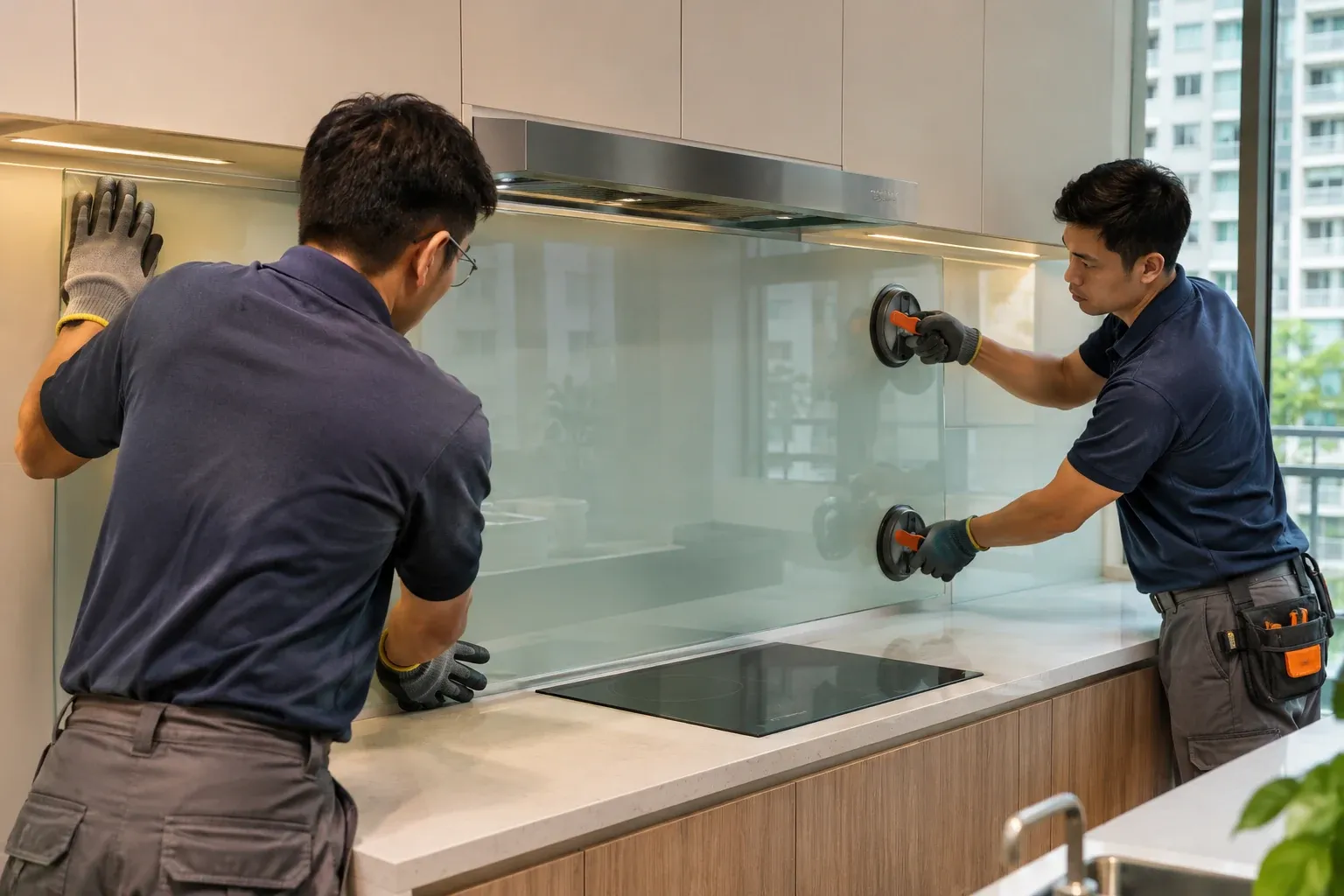
How kitchen backsplash glazing is planned and installed
Discuss the kitchen layout, hob type, preferred colour, glass finish and intended coverage.
Measure the site and record cabinet lines, countertop levels, corners, sockets and appliance clearances.
Confirm the glass product, thickness, edge finish, cut-outs, paint or tint and fixing system before fabrication.
Have the panel cut, processed and toughened to the approved dimensions; check the finished edges and openings.
Prepare the wall, install the panel with compatible fixing materials, seal the joints where specified and inspect the finished work.
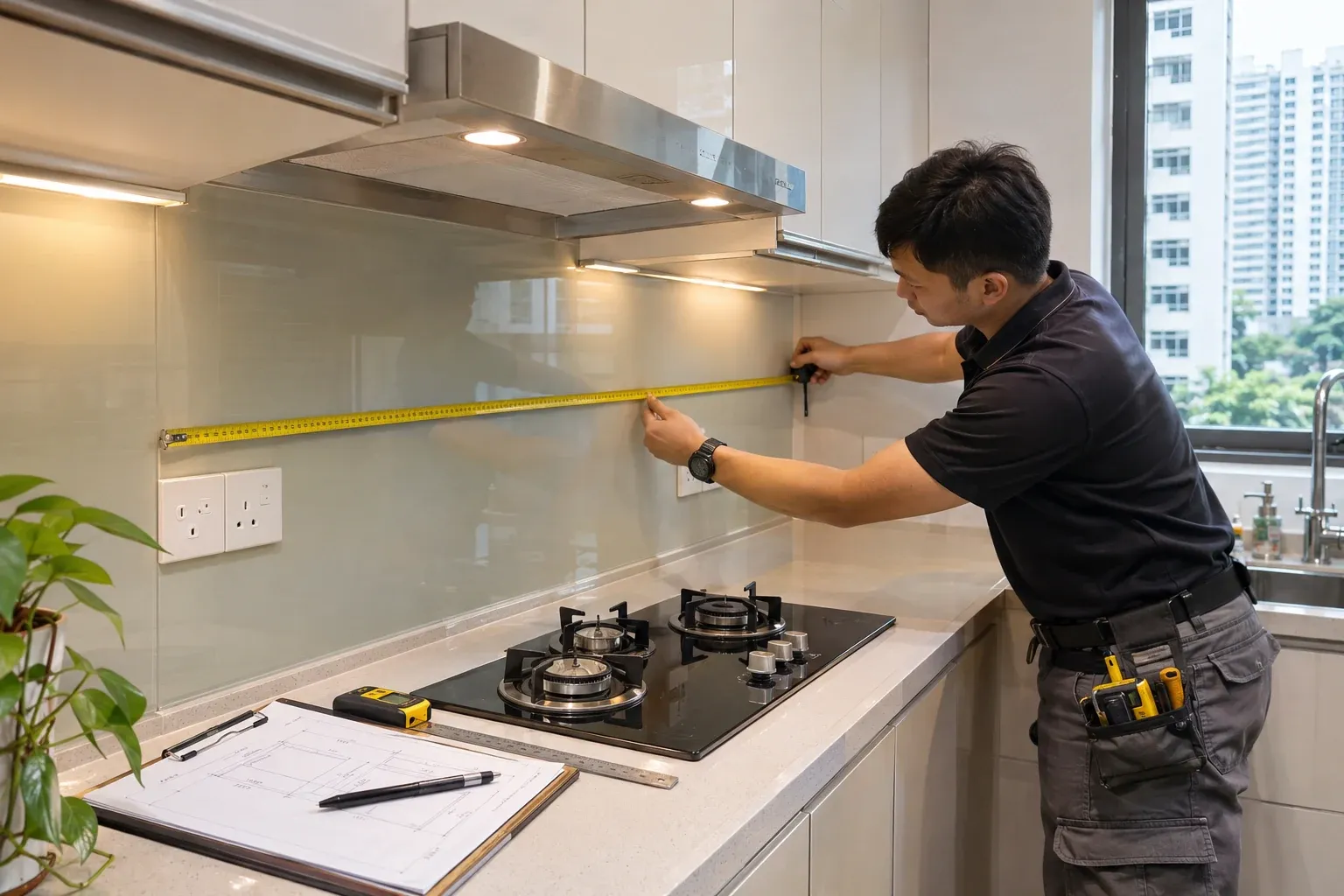
Common mistakes to avoid :
Choosing glass by thickness alone without checking whether it is the correct glass type.
Measuring before the final cabinet, countertop or appliance positions are confirmed.
Forgetting socket and switch cut-outs until after the glass has been toughened.
Ignoring the hob manufacturer’s clearance and installation instructions.
Installing onto a damp, uneven or poorly prepared wall.
Using an adhesive or sealant without checking compatibility with the glass backing and wall surface.
What affects the cost of a glass backsplash in Singapore?
A reliable quotation needs more than the kitchen’s approximate width. Price can change with the total glass area, thickness, glass type, colour or low-iron upgrade, number of cut-outs, edge polishing, joints, wall preparation, access and installation complexity. Ask the contractor to itemise the glass specification, fabrication, cut-outs, installation, sealant and any exclusions so that quotations can be compared fairly.
Frequently asked questions :
What is the best glass thickness for a kitchen backsplash in Singapore?
For many standard residential kitchens, 6 mm toughened glass is a practical starting point. Confirm the final specification against the panel size, hob location, glass product and fixing method.
Is 6 mm toughened glass suitable behind a gas hob?
It may be suitable when the selected product and installation are approved for that location. The installer must check the gas hob manufacturer’s clearance and instructions before confirming the layout.
Is 8 mm glass always better than 6 mm?
No. 8 mm may be useful for certain larger panels or where the fabricator specifies it, but extra thickness does not automatically make every installation safer or better.
Can I use back-painted glass for my kitchen backsplash?
Yes, back-painted glass is a common design option. Confirm the paint system, glass type, safety specification and installation method with the supplier before ordering.
Can the glass be cut around power sockets?
Yes, openings can be planned during fabrication. Socket positions and dimensions must be confirmed before the glass is toughened; later cutting or drilling is generally not possible.
Does a glass backsplash need special wall preparation?
The wall should be clean, dry and suitable for the selected adhesive or fixing system. Porous or uneven surfaces may need preparation according to the glass and adhesive manufacturers’ instructions.
Can glass backsplash panels be installed in HDB flats, condominiums and landed homes?
Glass backsplash panels can be specified for these home types. The actual design must suit the kitchen layout, site conditions, access and any applicable renovation or building-management requirements.;
Plan your kitchen glass backsplash :
If you are planning a kitchen renovation or replacing an existing backsplash, confirm the glass thickness only after the panel dimensions, hob position, finish and fixing details have been reviewed. RH Glass Solution provides kitchen and interior glass options, including 6 mm tempered kitchen panels, custom cut-outs, colour finishes, measurement, fabrication and installation.
Explore the Kitchen & Interior Glass Singapore service or contact RH Glass Solution on +65 8616 1337 to discuss your kitchen layout.
Written by
Rh Glass solution
Part of the RH GLASS SOLUTION PTE LTD team: 24/7 glass replacement, installation and repair across Singapore.
You might also like
All articles