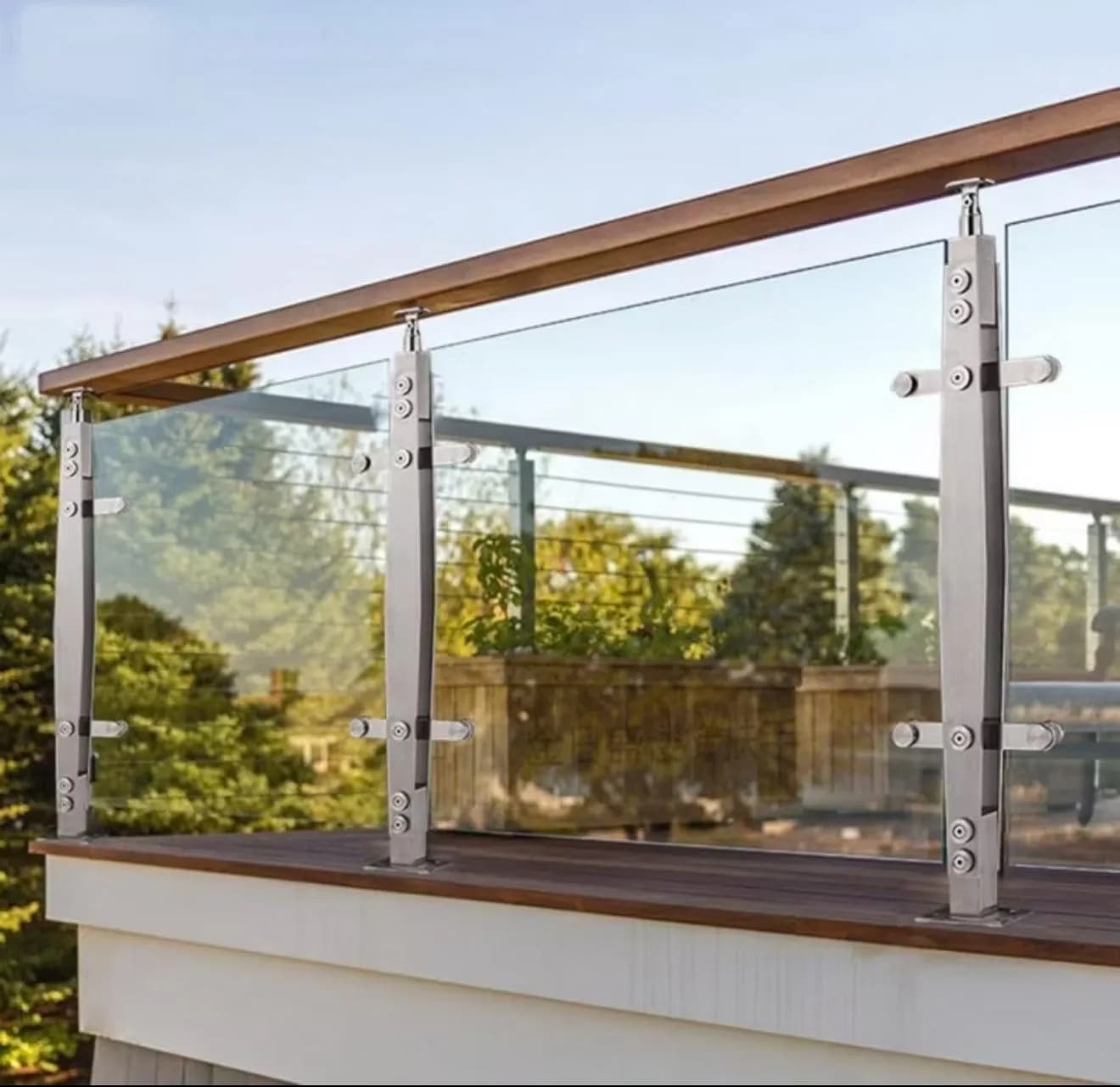
Glass Railing & Balustrade Singapore: Safety, Cost and BCA Requirements
Glass Railings and Balustrades in Singapore: A Safety-First Guide
Glass railings are one of the most transformative elements in modern architecture. They preserve views, transmit light and make balconies, staircases and terraces feel open rather than enclosed. But a railing is also a life-safety component — it must resist people leaning, pushing and occasionally colliding with it.
In Singapore, glass railings are subject to Building and Construction Authority (BCA) requirements. This guide explains what those mean in practice, what systems are available, and what they cost.
Why Glass Railings Are Popular in Singapore
- Unobstructed views — critical for condominiums and waterfront properties.
- Daylight and openness — no visual clutter on balconies and staircases.
- Weather resistance — no painting or rust treatment needed.
- Design flexibility — works with modern and minimalist architecture.
- Low maintenance — clean with glass cleaner and a cloth.
- Perceived space — makes small balconies feel considerably larger.
BCA Requirements for Glass Railings
Singapore's building regulations require barriers — including glass balustrades — to resist specified loads. Key design principles:
- Horizontal line load — barriers must resist a horizontal load applied at the top, typically in the range of 0.75 kN/m for domestic and up to 1.0 kN/m or more for public and commercial areas.
- Concentrated load — must also resist a concentrated load applied at any point.
- Height — generally a minimum of 1,000 mm for balconies and 900 mm for internal staircases, though specific requirements depend on the building type and fall height.
- Glass type — must be tempered or laminated safety glass, with laminated strongly preferred to retain fragments on failure.
- Infill and gaps — openings must prevent a sphere of a specified diameter from passing through.
- Fixings — anchors must be rated for the load and suitable for the substrate.
Never commission a glass railing purely on price. A railing that has not been engineered for load is a genuine danger, particularly on high floors and in public areas.
Glass Thickness and Build-Up
| Application | Recommended Glass | Notes |
|---|---|---|
| Internal staircase | 10 mm tempered | Lower loads, protected environment |
| Balcony, low-rise | 12 mm tempered | Minimum for most external use |
| Balcony, high-rise | 12 mm tempered or 6+6 laminated | Wind loading matters |
| Public / commercial | 12 mm tempered or 8+8 laminated | Higher load requirements |
| Feature and curved | 12 mm tempered, template-made | Custom radius |
Laminated glass is increasingly specified because it retains fragments if broken, greatly reducing the risk of glass falling from height.
Railing Systems Compared
Spigot-Mounted
Glass panels held by stainless steel spigots bolted to the floor or slab. Base-mounted, no continuous channel.
- Look: Fully frameless, minimal visual interruption
- Installation: Base must be level; each spigot independently anchored
- Best for: Balconies, terraces, pool surrounds
U-Channel (Base Shoe)
A continuous aluminium or stainless steel channel fixed to the floor, holding the glass along its base.
- Look: Clean continuous line, very frameless
- Installation: Requires a level base; setting blocks and gaskets used
- Best for: Staircases, walkways, long runs
Stainless Steel Posts with Glass Infill
SS posts at intervals with glass panels between them.
- Look: More traditional, more visible hardware
- Installation: Most forgiving of uneven substrates
- Best for: Industrial settings, budget projects, high-load areas
Standoff-Mounted (Side-Fixed)
Glass fixed to the side of a structure using stainless steel standoffs.
- Look: Floating appearance
- Installation: Requires a suitable vertical structure
- Best for: Feature walls, mezzanines
| System | Aesthetics | Installation Difficulty | Cost | Best For |
|---|---|---|---|---|
| Spigot | Excellent | Medium | $$$ | Balconies, terraces |
| U-Channel | Excellent | High (base level critical) | $$$$ | Stairs, long runs |
| SS Posts + Glass | Good | Low | $$ | Budget, industrial |
| Standoff | Very Good | Medium | $$$ | Feature walls |
Stainless Steel Grade: 304 vs 316
Singapore's humidity and coastal environment punish low-grade hardware.
- SS 304 — suitable for sheltered and indoor installations.
- SS 316 — required for coastal locations, pool surrounds and exposed balconies.
- SS 316L — for marine environments and high-chloride exposure.
Rust streaks on glass and staining on spigots are almost always a sign of incorrect grade selection.
Glass Railing Cost in Singapore
| System | Specification | Cost per linear metre (SGD) |
|---|---|---|
| SS posts + glass infill | 10 mm tempered | $280 – $450 |
| Spigot-mounted frameless | 12 mm tempered | $480 – $800 |
| Spigot-mounted frameless | 6+6 laminated | $600 – $950 |
| U-channel frameless | 12 mm tempered | $550 – $900 |
| U-channel frameless | 8+8 laminated | $700 – $1,150 |
| Curved glass railing | 12 mm tempered, bespoke | $900 – $1,600 |
| SS handrail addition | SS 304/316 | $120 – $260 |
A typical 5 m condominium balcony railing in 12 mm tempered glass with spigots commonly lands between $2,400 and $4,000 installed.
Handrails: Do You Need One?
Not always. Frameless glass railings without a handrail give the cleanest look and are common on residential balconies. However, a handrail may be required or advisable when:
- The location is a staircase or ramp.
- The building is public or commercial.
- Elderly or mobility-impaired users are expected.
- Building management or the architect specifies it.
Handrails can be stainless steel tube, flat bar or a glass top edge, mounted on posts or cantilevered from the glass.
Installation Considerations
- Structural adequacy — the slab or beam must be capable of taking the anchor loads.
- Base level — spigot and U-channel systems demand a level base. A sloping balcony floor requires packers or a levelling screed.
- Waterproofing — anchors penetrating a waterproofed slab must be sealed correctly to prevent leaks into the unit below.
- Expansion — glass and metal expand differently; gaskets and setting blocks must allow movement.
- Templating — curved and raking runs must be templated on site, not derived from drawings.
- Lifting — large panels require suction lifters and, at height, rope access or crane assistance.
Maintenance
- Clean glass with a non-ammonia cleaner every 4–8 weeks.
- Inspect spigots and anchors annually for tightness.
- Check gaskets for hardening or shrinkage.
- Look for rust staining, which indicates grade or coating failure.
- Check silicone joints at the base for cracking.
- Immediately report any chip on a glass edge — edge damage is where failures begin.
Frequently Asked Questions
Is glass railing safe?
Yes, when correctly engineered, tempered or laminated, and installed to BCA load requirements. It is less safe when installed without engineering, using undersized glass or low-grade fixings.
How much does a glass railing cost in Singapore?
Between roughly $280 and $1,600 per linear metre depending on system, glass type and complexity.
Can I use laminated glass instead of tempered?
Yes, and it is often preferred because it retains fragments. Laminated tempered combines both benefits.
Do I need a handrail?
Not always for private balconies, but generally required for staircases, ramps and public areas.
How long does installation take?
A typical balcony railing is installed in one to two days, plus fabrication lead time of 7–14 days.
Engineered Glass Railings by RH Glass Solution
We design, fabricate and install glass railings and balustrades across Singapore, using SS 304 and SS 316 hardware and 12 mm tempered or laminated glass.
- Phone / WhatsApp: +65 8616 1337
- Email: rhglasssolution@gmail.com
- Website: www.rhglasssolution.sg
- Hours: 24 hours, 7 days